Where Spraying Really Makes (Or Breaks) Profitability
Rethinking Efficiency in Modern Orchard and Vineyard Spraying
Modern crop protection has moved far beyond the idea of simply applying chemicals to plants. Today, profitability hinges on a far more precise question: how much of the spray actually reaches and remains on the target where it is needed.
Whether in vineyards, citrus orchards, nut trees, or stone fruit blocks, the goal of spraying is no longer volume — it is effective deposition. The difference between a successful spray program and a costly failure lies in understanding air, droplet behaviour, and equipment performance as a single integrated system.
The Hidden Cost of Poor Deposition
In most spray programs, the chemical itself represents the single largest variable cost. For high-input crops, these figures are substantial:
– 3Citrus programs can reach R80,000 per hectare
– Table grapes average R40,000 per hectare
– Apples sit near R38,000 per hectare
– Plums and nectarines can exceed R20,000 per hectare
– Pecan nut programs approach R20,000 per hectare
Yet even with this level of investment, many producers unknowingly lose a significant portion of their active ingredients due to inefficient spraying. Poorly calibrated equipment, worn components, and incorrect air management can result in losses of up to 40% of
applied product.
On a 40-hectare citrus operation, that equates to R1,280,000 lost per year — not through resistance or poor chemistry, but through ineffective delivery.\
Spraying Is About the Target — Not the Tree or Vine
One of the most common mistakes in spraying is treating the crop as the target. In reality, the true target is far more specific:
– a disease infection site,
– a pest habitat within the canopy, or
– a physiological zone requiring nutritional support.
Vineyards and orchards present complex canopy structures, with varying densities, training systems, and row spacing. Achieving consistent coverage across exposed and shaded areas requires a deliberate balance of droplet size, air velocity, and penetration
Droplet Size: Small Decisions, Big Consequences
Droplet spectrum plays a critical role in deposition efficiency:
– Larger droplets tend to deposit quickly on exposed surfaces but struggle to reach inner canopy zones.
– Finer droplets improve penetration and surface coverage, especially in dense canopies, but carry a higher risk of drift if not properly controlled.
The physics are compelling. From the volume of a single 300-micron droplet, it is possible to generate 27 droplets of 100 microns. When combined with diffusion effects around foliage, the effective coverage area can increase by nearly tenfold.
The challenge lies in generating droplets that are small enough to penetrate — but stable enough to remain
on target.
Air Is the Carrier — Momentum Is the Risk
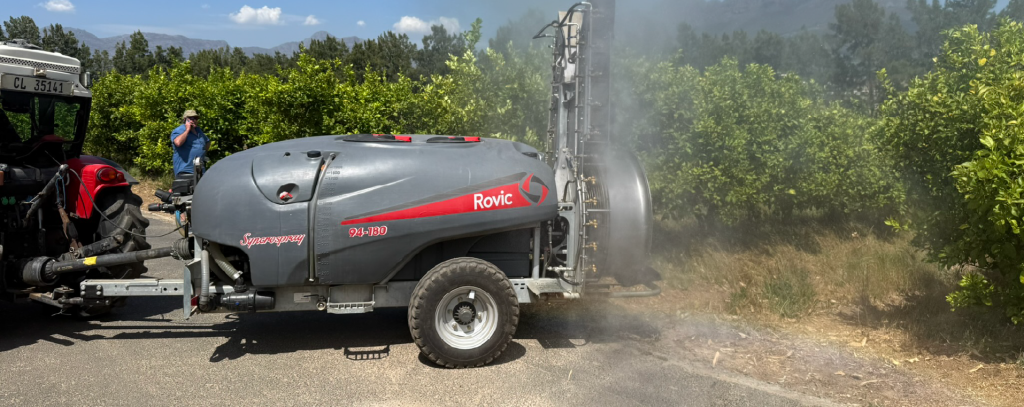
Airflow is the engine that moves spray droplets into and through the canopy. The objective is not brute force, but controlled momentum.
Effective spraying requires enough air energy to:
– separate leaves and fruit,
– carry droplets into shaded zones,
– and distribute spray throughout the canopy volume.
However, if air velocity does not dissipate inside the canopy, spray is simply carried out the other side. In practical terms, this means money leaving the orchard or vineyard.
The ideal outcome is for air momentum to dissipate to virtually 0 m/s on the far side of the canopy, leaving only a gentle “puff” as air exits — a sign that spray has been captured rather than lost.
Understanding the Mechanics of Effective Deposition
Rovic’s philosophy centres around four interlinked spray mechanics that govern deposition efficiency:
– Projection – carrying atomised spray to the outer edge of the canopy.
– Penetration – opening the canopy to allow spray-laden air to enter.
– Distribution – moving spray throughout the entire canopy volume.
– Retention – ensuring droplets adhere to target surfaces, including shaded zones
When one of these elements fails, efficiency drops.
Technology Built for Real-World Spraying
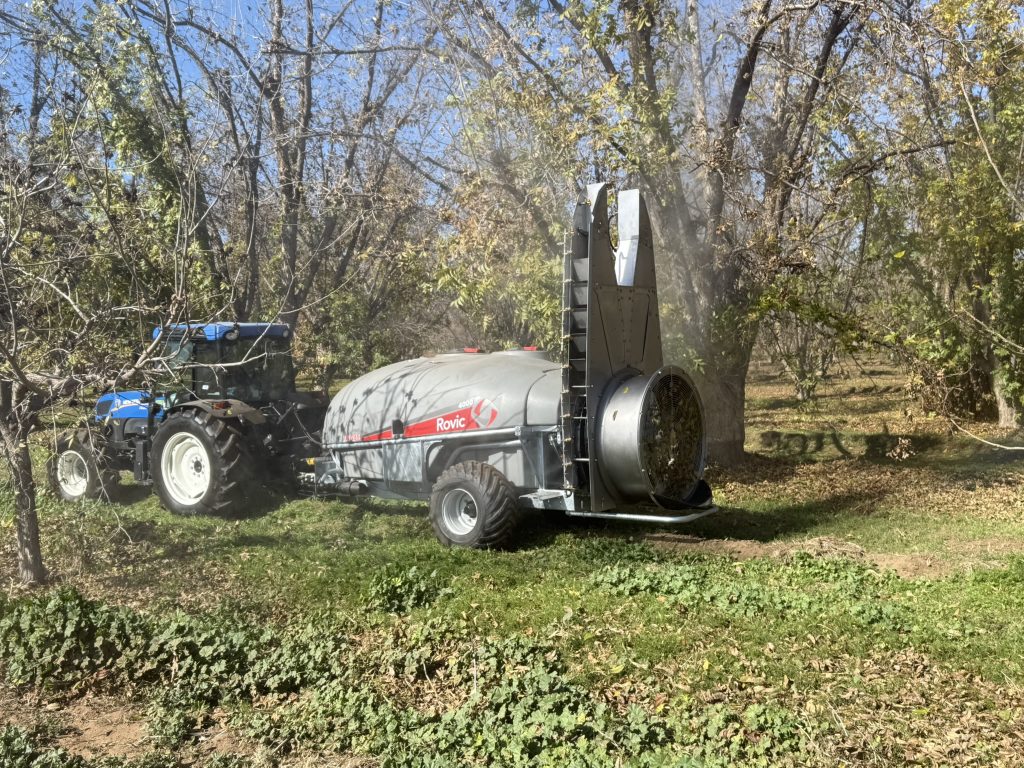
Designed for modern vineyards and orchards, the Syncrospray Next Gen range spans nine models across five families, from delicate canopies to 15-metre-high pecan orchards.
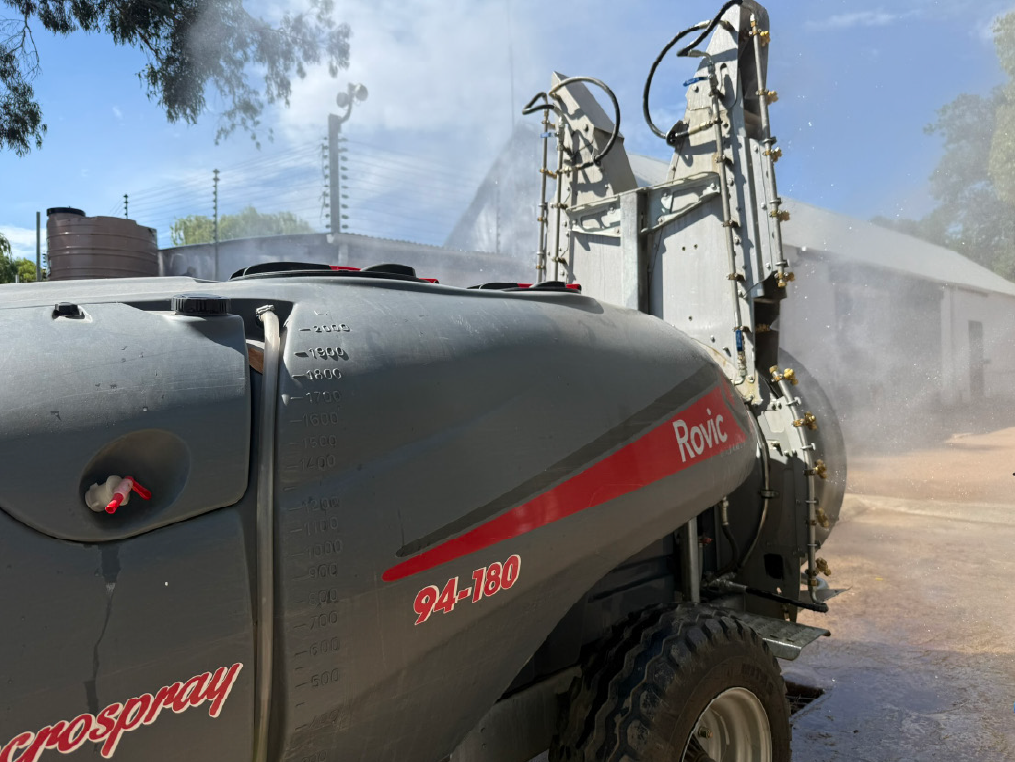
Syncrospray 112-265
At the top of the range, the 112-265 is engineered for high-demand canopies, combining:
– a 112 cm fan delivering up to 75,700 m³/h of airflow,
– a patented 3.3m Superflow® turret for tall, dense tree crops and
– a 265 ℓ/min piston pump capable of consistent delivery beyond 15 metres.
This ensures effective penetration without excessive loss.
Small Components, Big Losses
Nozzles are among the most overlooked sources of inefficiency. Operating at pressures of up to 20 bar, worn nozzles can cause flow-rate variations of up to 40% after just 100 hours. On a 40-hectare citrus farm, this equates to potential chemical losses of R1,280,000 per year.
Replacing a full set of nozzles costs approximately R2,400 — a minor expense with a significant return.
Speed, Timing, and Recovery
Operating speed directly affects deposition. Increasing tractor speed from 3.5 km/h to 5 km/h can reduce chemical recovery in dense canopies by as much as 40%.
Spraying conditions also matter. Night applications reduce UV degradation and atmospheric instability, improving droplet survival from nozzle to target.
Maintenance vs. Chemistry
Annual sprayer maintenance costs about R1,273 per hectare versus chemical investments up to R80,000, making precision spraying essential for yield and long-term profitability.
Precision That Pays
Effective spraying isn’t about more product, but efficient use—through proper equipment, maintenance, airflow control, and correct operating practices to reduce losses.
In modern agriculture, the most profitable spray program is the most precise, not the most expensive.