The Mulching Revolution
The practice of farming is inextricably linked to the evolution of human civilisation. Modern farming and transport have shaped our entire planet and the way we live on it.
The evolution of farming saw the most fertile ground gradually converted to crops and livestock, and populations evolved and developed in those areas. Humans have been able to settle in large numbers in all corners of the globe directly as a result of farming, food preservation, and food transport and storage. Dubai would still be a small fishing village were it not for the rapid evolution of these technologies.
However, the evolution of farming technology has reached the point where it comes at a higher and higher cost as the human population increases. The greater population means more food is required, and that can only be accomplished by increased productivity per hectare or by farming more and more marginal ground. Farming marginal ground means greater inputs to achieve yields, and unfortunately, because farming is seasonal, so many of the decisions are made from season to season and yield to yield.
We must collectively accept that: “We do not inherit the earth from our ancestors, we are borrowing it from our children.” This should be the bedrock on which all farming is practiced – sadly, it is not. Modern farming feeds the modern world, which is more and more detached from the land, to its own detriment. The evolution of corporate agriculture means too often decisions are made in boardrooms, not in the field. Farmers competing for increasingly marginal yields are forced to make critical economic decisions, not sound agricultural ones. The glare of the bank manager is tragically more intimidating than the degradation of the soil.
As above, so below.
This ancient saying is true to so many aspects of life, but perhaps it sums up farming best of all. The incredible complexity of our soils is so misunderstood and therefore so easily taken for granted. The ancient Upanishad saying, “Be careful where you place your feet because you trample on the ceiling of a magical world,” is lost in the noise of maximising this year’s yield and settling the overdraft.
A teaspoon of soil contains more organisms than there are people on Earth because healthy soil is home to billions of microorganisms like bacteria, fungi, protozoa, and nematodes, far exceeding the world’s human population. Tragically, our understanding has not advanced much since the 1400s when Leonardo da Vinci famously said: “We know more about the movement of celestial bodies than about the soil underfoot.”
However, what we are beginning to realise is that soil health is tied inextricably to human health and longevity. This alone is not enough to bring about critical changes to farming practice, but the realisation that prioritising short-term “synthetic” yields at almost any cost has massive downstream costs and consequences. In a world driven by quarterly results, quick fixes, and instant gratification, making soil a priority requires passion, awareness, education, and obviously, results.
Mulching Innovation
Mulching technology has evolved incredibly over the last few years, but it is, in fact, as old as the Earth itself. Mulching is the process of recycling surface organic material to feed the soil – As above, so below.
The original mulchers were vast herds of animals, like bison, aurochs, and African migrations, trampling organic material and manure back into the soil year after year – a perpetually balanced, harmonious cycle of renewal and regeneration.
Contemporary mulches mirror this dynamic: they buffer soil temperature, boost moisture, reduce runoff and erosion, and increase soil organic carbon.¹ The work of the Allan Savory Institute and ranchers practicing high-density grazing is transforming degraded farmland worldwide. Where livestock can’t work – like orchards and vineyards – mechanical mulching under the row returns organic matter, suppresses weeds, and improves soil properties.²
Mulching can now be done almost anywhere, with machines even deliverable by helicopter. Any mulching is better than leaving soil naked. While some argue burning is cheaper, it wastes valuable organic material. Mulching converts it into a porous, oxygen-rich blanket, creating a sustainable cycle of soil enrichment with minimal future inputs.
The value of mulching is determined by your philosophy: are you farming for your children or your pocketbook? Most often it’s a combination, and the balance between regenerative farming and profitability is critical.
Our Mulching Evolution
At FarmItaly, we started mulching in the most primitive form 17 years ago. Huge areas of our farm had been seasonally burnt using a very cheap slash-and-burn mindset because each burn brought green shoots for the cattle – but each year the landscape deteriorated, and the climax grasses began to disappear, the unpalatable increaser grasses began to dominate, and the carrying capacity diminished with each season. We attempted high-density grazing, which worked fantastically, but in many areas, it was simply not possible because supplying water and managing fencing was not practical. In other areas, the vegetation was so thick we could simply not get animals into it in the first place.
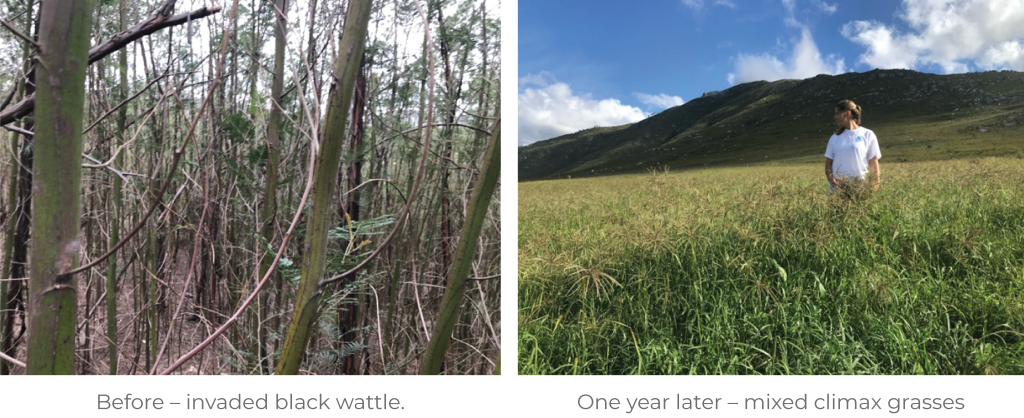
So began a very frustrating and expensive education – we paid our school fees. We tried every mulcher, slasher, and tractor combination. We broke mulchers, tractors, gearboxes, and PTO shafts in the process, but slowly we began to see changes. Fields that would only hold cattle or buffalo for a week at a time started to hold them for two weeks – the endless sea of Sporobolus africanus (Suurpol) gave way to mixed climax grasses like Themeda triandria (Rooigras), Digitaria eriantha (Smuts finger), and Chloris guyana (Rhodes grass).
The cattle and buffalo held condition longer, the inter-calving periods dropped, flightless dung beetles began to appear, and suddenly there were earthworms everywhere. Most interestingly, our animals were rarely sick. Clients commented that our cattle and buffalo looked like they had been polished.
All of this was accomplished without a drop of herbicide or pesticide. Challenging the cut, stack, and burn approach to black wattle has been like fighting the tide, but land that was deemed valueless is now regenerative and productive. Degraded sand has been turned into thriving soil. Spontaneous Afro-montane forest is erupting where mono-culture black wattle was fully invasive and entrenched. Magic and balance have returned to the soil, and the reason is astronomically simple – our soil carbon levels have gone from as low as 0.5 percent to as high as 7 percent.
I am not a soil scientist – far from it – but when I pick up a handful of soil in the middle of a field and it smells like the forest floor, I know I am on the right track.
Each percentage of carbon in the soil can retain as much as 1.25 million litres of water per hectare. Mulching hugely boosts soil carbon, and evenly distributed mulch is a porous, oxygen-rich blanket that protects the soil life and gradually becomes the soil. It is a miraculous recycling and regenerative process that massively increases drought resistance and survivability. In times of extreme drought, our mulched areas rescue us.

At FarmItaly Imports, we have always been conservation-driven farmers, striving to find the difficult balance between farming regeneratively and remaining financially sustainable. We have tested every mulcher, tractor, excavator, and skid steer combination we could lay our hands on. We travel overseas annually to all the trade fairs to examine best practice and test machines.
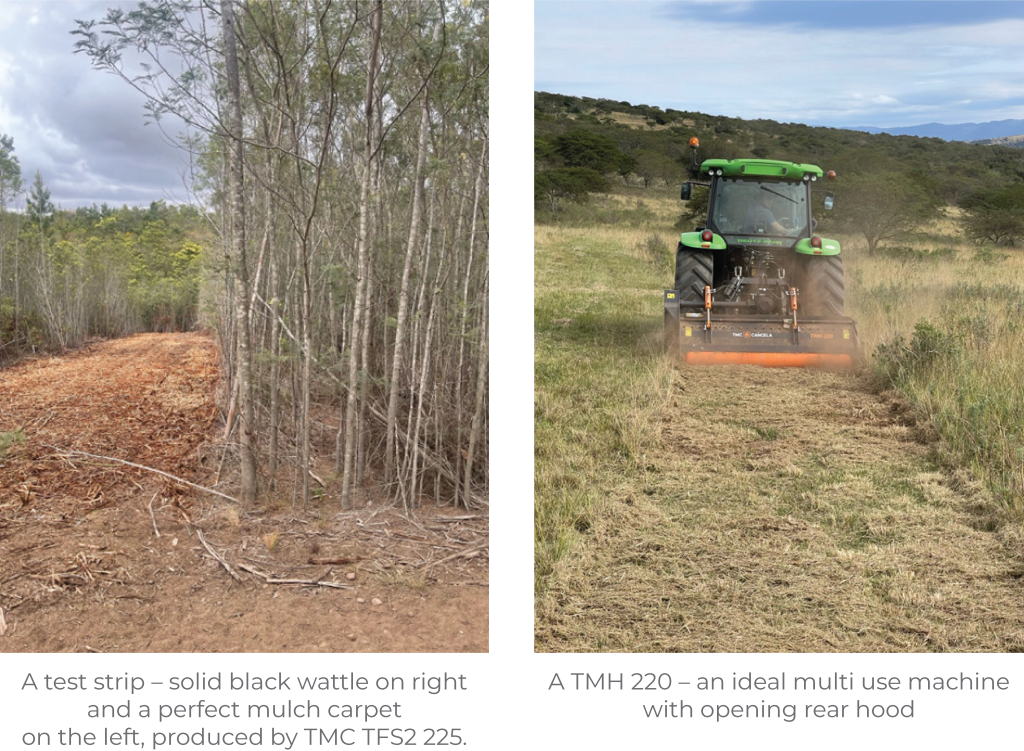
As a result of all our rigorous on-farm testing, we chose to partner with TMC Cancela – a family-owned business that offers the best machines, service, integrity, and support. The machines are made with Flexi Steel, which is quite simply Africa Tough. Everything is over-engineered, and the market-leading patents and innovation make TMC the best option for almost any mulching solution in South Africa.
We are passionate about mulching and the enormous benefits it can bring to most landscapes. We love to demonstrate the incredible capacity of these machines on our farm in the Western Cape and welcome and encourage clients to experience these machines firsthand. Please contact us for personalised demos.
Contact: Lindsay Hunt on 082 782 7762 or email info@farmitalyimports.com
¹ Dengxing Fan, Guodong Jia, Yangyang Wang, Xinxiao Yu, The effectiveness of mulching practices on water erosion control: A global meta-analysis, Geoderma, Volume 438, 2023
² Cabrera-Pérez C, Valencia-Gredilla F, Royo-Esnal A, Recasens J., Organic Mulches as an Alternative to Conventional Under-Vine Weed Management in Mediterranean Irrigated Vineyards, Plants (Basel), 2022 Oct